My niece asked me to buy her a Bible, and because she is still in elementary school, I bought her a nice looking Good News Bible Version.
Unfortunately, her mother (wife to my brother) who is also a disciple of a certain city pastor who some time back burnt many Bible versions which addressed Holy Spirit as Holy Ghost, and with missing verses. She caused havoc at home and asked me why, as a pastor, I would wish her daughter to go to hell because of reading a wrong Bible version.
I tried to explain to her how good the version was but she aggressively refused until I had to use my husband office and reminded her that I had bought the Bible for my daughter who is biologically closer to me than she is.
She insisted that the girl (her daughter) keeps the Bible at school but not in the house at home. She either had to do that or else she (the mother) would throw it away or burn it. I and my daughter (niece) decided to keep the Bible at school and if she ever came home with it, it had to remain in the bag where her mother could not see it.
Many have suffered what my niece, her mother and me suffered. Before I studied Theology, choosing a Bible was the easiest thing to do. I just had to go to a bookstore and choose two things: durability, colour and beauty.
Sometimes it could be an added advantage to find a Bible with pictures and some commentary in line with my religious beliefs. It did not matter then, whether it was KJV, NKJV, NIV, NASB, RSV, NRSV, GNT, CEV, NLT, LB, NCV, ESV, HCSB. What mattered was the kind of English and once it wasn’t the THEE, THOU, and BRETHREN, I was sorted.
Now that I know that the Bible was not originally written in English or in my mother tongue, but a translation; the choice of a Bible is a little bit difficult.
It matters that we understand that the Old Testament writers used Hebrew, a Semitic language which is written from right to left and had no vowels. (In the Old Testament, a few passages, especially in the book of Daniel, were written in a related language called Aramaic). As for the New Testament, it was written utterly in Koine Greek, though in a form that differs substantially from the modern Greek spoken today.
In the Christianity, there are two serious questions about Bible versions mostly asked:
- Why are there so many Bible versions?
- Which of all these versions is the best?
The answer to the first question is, there are many because all Bibles (not in Hebrew and Greek) are translations. All Bibles in English and other vernaculars are translations and that is the reason as to why there are many versions. The answer to the second question is a difficult one.
The best Bible version is not one that can be determined by a preference but rather by expertise. It is a question that can be answered based on how much one knows about the art and science of translation (this I will handle in the future).
For now, let me provide a working definition of what the art and science of translation are:
Translation is an art and a science that provides a structure that includes a processes and a linguistic function that enables the audience of a receptor language (RL) to systematically in a communicative manner discover and verify reliable knowledge.
Translation forms an intuitive and cognitive process, transporting and producing texts, meaning and genres cross-culturally, thereby dynamically remaining intentionally communicative.
The process of translation suffers an add and drop syndrome. Some Bible versions dropped some literal content (Hebrew/Greek) due to lack of an equivalent in the Receptor Language (RL) for a term/phrase in the Source Language (SL). In some cases, other translations added words and phrases which were not in the original text (SL) but communicative in the RL.
Those of you who have sat in an audience where the speaker’s words are being translated and you happen to know both the source language (SL) and receptor language (RL), tend to understand more than those depending on only one.
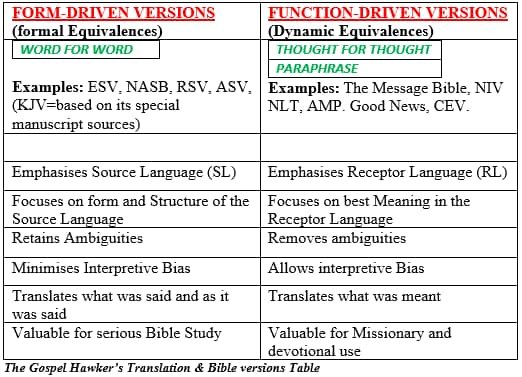
Biblical translation, therefore, is a two-dimensional practice. Some Bible versions are Form-Driven Versions focusing on formal equivalences while other versions are Function-Driven versions committed to Dynamic Equivalences. With the formal equivalences translation versions, the emphasis is on the preservation of the syntactical structure as they translate word-for-word.
These versions operate as a dictionary though in a narrative form. They don’t essentially make interpretive decisions for the reader but leave it to the reader to read deep and inductively conclude.
Dynamic equivalences, on the other hand, are not literal but free translation versions. Their mission is to ensure the thought of the original author in the SL is communicated to the modern reader in the RL.
In doing this, they paraphrase and make interpretive decisions for the reader to convey the passage’s meaning. While in the formal equivalence readability and clarity is work to be done by the reader, in the Dynamic equivalences this work is done for the reader.
Form-Driven Versions are therefore literal in nature but Function-driven Versions are free in nature. It is, however, important that we understand that though this is true, it is also true that translation being a translation; no translation is ever entirely literal or entirely free.
Because Language is a giant science and its dynamics alternate intuitively and cognitively in every circumstance, we cannot assume that formal equivalence translations are better than the Dynamic equivalences translations, or the reverse.
We can only pray that we are helped to read the original text, we also have to be competent enough in the receptor language if we are to appreciate our Bible.
God bless you and: THINK & UNDERSTAND (2Tim 2:7 NLT)
Pr ITM WHITE
The Gospel Hawker
iTiS Well of Worship Fellowship (John 4:24)
 iTiS Well of Worship Fellowship (John 4:24)