23rd January Morning
Leviticus 23-24
If you have been reading this book together with the summaries that I have provided in this book, then you will realize that the book of Leviticus is an interesting one. The chapters that am going to handle are those that handle two important things in both the History and Theology of Israel.
Chapter 24 is about rules and if you have been reading this book, by now you know the how and the why of rules. These will be revisited when we get to the New Testament. For now allow me outline these chapters and B. Yeager says that chapter 24 is one that is about Sundry rules 24:1-23:
- Oil for the tabernacle lamps (24:1-8)
- Twelve cakes of fine flour – showbread (24:5-9)
- Blaspheming God punished by death (24:10-16)
- Eye for an eye and tooth for a tooth (24:17-23)
These were functional rules that every organized society that handles any serious business should have. I hope your community has some and I also hope they are not mystified and worshiped as they were in the cult of Judaism.
Chapter 23 is one about the feasts and Holy days, this how it can be summarized:
- Passover (23:4-5)’
- Unleavened Bread (23:6-8)
- First Fruits (23:9-14)
- Pentecost, or first fruits (23:15-21)
- Feast of trumpets, New Year’s day of civil year (23:22-25)
- Day of atonement (23:26-32)
- Feast of tabernacles (lived in booths) (23:33-44)

Gavin writes: “Abraham received a twofold promise from YHVH/God. He was promised not only a land, (Eretz Israel), with a City, Jerusalem), but he was also given a promise of descendants as numerous as the stars of heaven. (Genesis.15:5) This “melo-hagoyim” or a multitude of nations/gentiles/goyim would come to salvation in precisely the same way the old saints of Israel came to salvation. They would be saved by the grace of the Almighty YHVH, the God of Israel, through the exercise of their own personal faith in the atoning blood of the sinless perfect Sacrifice Lamb He had promised.
Eventually this company will be regathered. And this remnant would be saved and glorified together as one magnificent single restored united family, even a royal priesthood and a holy nation. Oh yes. The God of Abraham, Isaac, and Jacob is into “family values”. He cares about His family in a very big way”. It is important to note that the Feasts that symbolize a sequence of events, were given by God in a set chronological order.
Therefore the events that they symbolize will take place in the same exact order. I have read way too many interpretations of the Feasts that jump backwards and forwards between them in an effort to make them fit into pre-conceived end time scenarios. What we need to do is make the order of the Feasts our guideline to coming events, instead of scrambling them to fit our ideas.
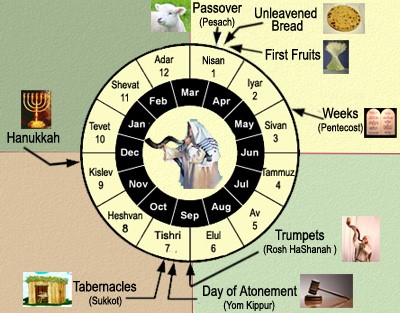
I cited this from inplainsite.org. Where I even borrowed the following article.
The First Four Feasts [Leviticus 23]
- Pesach or Passover: On the fourteenth day of the first month at twilight is the Lord’s Passover. [Leviticus 23:4] The Hebrew word “Pesach” means to pass over, to exempt or to spare. Passover, which begins on the 14th day of Nisan (the first month of the Jewish calendar) celebrates the epic exodus of the nation of Israel out of bondage. The Jews had been slaves in Egypt for generations, but were refused their freedom despite plague after plague being visited by God, on the Egyptians, through Moses.
However the night before the final ‘plague’ which caused Pharaoh to change his mind, the Israelites were given very explicit instructions. They were to sacrifice a lamb and place the blood upon the door posts and lintels of their homes. That night the angel of God “passed over” the houses of the Jews that were covered by the lamb’s blood, but caused the death of the first-born of all families in the houses that were not. Every year, at the Passover feast there would be a reenactment of this ritual to remind the Israelites of their deliverance from slavery under the Pharaohs of Egypt. [Exodus 12:1-14]
Jesus fulfilled this feast both symbolically, and quite literally and this how: On the 10th of Nisan, Jesus rode into the city of Jerusalem on the very day the lambs to be slaughtered were selected. He entered the city as the sacrificial Lamb chosen by God, which however was not understood by the people at the time. Four days later Jesus was crucified on the day of preparation for the Passover, when the lambs were actually slaughtered (John 19:14 tells us that that as Jesus stood before Pilate; it was the day for the preparation of the Passover and it was about the 6th hour).
These four days were fulfilled by Jesus during the Passover week. Jesus entered Jerusalem and went to the Temple, which was the house of God, and went on public display there for four days, from Nisan 10 to Nisan 14. During this time, Jesus was examined by many in fulfilling this Scripture, including; The chief priests and elders (Matthew 21:23); Pilate (Matthew 27:1-2, 11-14, 17-26); Herod (Luke 23:6-12); and Annas, the high priest (Luke 3:2; John 18:13, 24). The Passover lamb was to be a “male without defect,” which is how Jesus was described.
For you know that it was not with perishable things such as silver or gold that you were redeemed from the empty way of life handed down to you from your forefathers, but with the precious blood of Christ, a lamb without blemish or defect. (1 Peter 1:18-19)
Jesus’ bones remained unbroken, which was Moses’ stipulation for the Passover Lamb in Exodus 12:46. It was customary to break the leg bones of the person after a few hours of crucifixion so that the person could not push up with their legs in order to breathe. Breaking the legs ensured that death by asphyxiation followed very quickly. However, while the Romans broke the legs of the two thieves crucified on either side of Jesus, they did not do so with Jesus who was already dead. [John 19:31-34]
However, the full extent of the symbolism is only realized when viewed from a Christian perspective. John the Baptist called Jesus the “Lamb of God who taketh away the sin of the world.” [John 1:29] A fact that Paul emphasized when he said that… “… Christ our Passover is sacrificed for us.” [1 Cor. 5:7]. As the destroyer “passed over” every home on which he saw the blood of the lamb, so God will “pass over,” (not execute judgment) every Christian who is protected by the blood of the lamb Jesus. This is accomplished by putting faith in the work of Jesus Christ on the cross.
- Unleavened Bread: And on the fifteenth day of the same month is the Feast of Unleavened Bread to the Lord; seven days you must eat unleavened bread. On the first day, you shall have a holy convocation; you shall do no customary work on it. But you shall offer an offering made by fire to the Lord for seven days. The seventh day shall be a holy convocation; you shall do no customary work on it.’ “[Leviticus 23:6-8] the feast of Unleavened bread began on the 15th of Nisan, which was the day following Passover, and continued for seven days until the 21st of Nisan. The first and last days of this 7-day feast were identified as “holy convocations” or High Sabbaths, devoted to rest and worship. [Leviticus 23: 6,8].
The day prior to a High Sabbath was commonly known as a preparation day which meant the Passover on the 14th of Nisan, was also the preparation day for the “High Sabbath” on the 15th. God commanded the Israelites to avoid eating any leavened foods (food that contained any fermenting product such as yeast or baking powder) during this festival, reflecting the fact that the Israelites had no time to put leaven in their bread before their hasty departure from Egypt (Exodus 12:33-34).
Note that at least six Biblical passages emphasize this prohibition of leaven during the feast (Exodus 12:14-20; 13:6-8; 23:15; 34:18; Leviticus 23:6; Deuteronomy 16:3, 8), the eating of which carried severe consequences. Seven days shall ye eat unleavened bread; even the first day ye shall put away leaven out of your houses: for whosoever eateth leavened bread from the first day until the seventh day, that soul shall be cut off from Israel. [Exodus 12:15] Unleavened bread shall be eaten throughout the seven days; and there shall no leavened bread be seen with thee, neither shall there be leaven seen with thee, in all thy borders. [Exodus 13]
Even modern day Jews who observe the traditional feasts go through a comprehensive and thorough search of their houses for any form of leavened food (chametz), every last crumb of which is removed from the house. Leaven, in the Bible always symbolized evil, sin and/or false doctrine.
Both Jesus and Paul warned about leaven. “Beware of the leaven of the Pharisees, which is hypocrisy.” [Luke 12:1] And Jesus said unto them, Take heed and beware of the leaven of the Pharisees and Sadducees. [Matthew 16:6; Luke 12:1) And he charged them, saying, Take heed, beware of the leaven of the Pharisees and the leaven of Herod. [Mark 8:15] “Your glorying is not good. Know ye not that a little leaven leaveneth the whole lump? [1Corinthians 5:6] Ye were running well; who hindered you that ye should not obey the truth? This persuasion came not of him that calleth you. A little leaven leaveneth the whole lump. [Galatians 5:7-9]
So why is leaven used as a symbol of evil? This question is probably best answered by the character and process of leavening, which is a process based on fermentation. Given time, the yeast reproduces, spreading throughout the dough or batter, biologically changing the chemistry of the dough as it works. Sin, like leaven, has a polluting quality. It doesn’t stay small or contained for very long, but quickly spreads, eventually affecting our entire being.
The symbolism of the feast of Unleavened Bread is that God’s people cannot continue in the same old patterns, but have to search out and remove every speck of sin in their lives. However, this is only possible after putting faith in the work of Jesus Christ on the cross.
- Firstfruits : And the Lord spoke to Moses, saying, “Speak to the children of Israel, and say to them: ‘When you come into the land which I give to you, and reap its harvest, then you shall bring a sheaf of the first fruits of your harvest to the priest. He shall wave the sheaf before the Lord, to be accepted on your behalf; on the day after the Sabbath the priest shall wave it. And you shall offer on that day, when you wave the sheaf, a male lamb of the first year, without blemish, as a burnt offering to the Lord. Its grain offering shall be two-tenths of an ephah of fine flour mixed with oil, an offering made by fire to the Lord, for a sweet aroma; and its drink offering shall be of wine. You shall eat neither bread nor parched grain nor fresh grain until the same day that you have brought an offering to your God; it shall be a statute forever throughout your generations in all your dwellings. [Leviticus 23:9-14]
The Feast of First-fruits, on the 17th day of Nisan, was a celebration of the harvest, when a sheaf representing the very first of the harvest was waved before the Lord, as a symbolic gesture that dedicated the coming harvest to Him. (This sheaf was likely to be barley, which was the first crop to ripen). However, there is some controversy as to the timing of this event. The Scriptures say the wave offering was made “on the day after the Sabbath”. Orthodox Judaism taking the position that it is the day following the “High Sabbath”, which was the first day of the seven-day Feast of Unleavened Bread.
Others believe that it was the day after the regular Sabbath that fell during the seven-day feast. Adding to the problem is that we are not sure exactly which year Jesus was crucified, various scholars having come up with different dates, usually ranging from 30 to 33 AD. However, since Jesus was crucified on the exact day of the Passover, we can be sure He rose on the festival of First Fruits. Remembering that the Jews counted their days from sundown to sundown, the likely scenario was that Jesus was crucified on Wednesday, and rose three days later after nightfall on Saturday evening when the regular Saturday Sabbath was over and the festival of First-fruits had begun… “on the day after the Sabbath”.
Jesus rose from the dead on the Feast of First-fruits. His resurrection was like a wave offering presented to the Father as the first-fruits of the harvest to come at the end of the age. The Apostle Paul said…”But now is Christ risen from the dead and become the first fruits of them that slept.“…”For as in Adam all die, even so in Christ shall all be made alive. But every man in his own order, Christ the first fruits, afterward they that are Christ’s at his coming.” [1 Corinthians 15:20, 23].
- Shavuot the Festival of Weeks or Pentecost: And you shall count for yourselves from the day after the Sabbath, from the day that you brought the sheaf of the wave offering: seven Sabbaths shall be completed. Count fifty days to the day after the seventh Sabbath; then you shall offer a new grain offering to the Lord. You shall bring from your dwellings two wave loaves of two-tenths of an ephah. They shall be of fine flour; they shall be baked with leaven. They are the first fruits to the Lord. And you shall offer with the bread seven lambs of the first year, without blemish, one young bull, and two rams. They shall be as a burnt offering to the Lord, with their grain offering and their drink offerings, an offering made by fire for a sweet aroma to the Lord. Then you shall sacrifice one kid of the goats as a sin offering, and two male lambs of the first year as a sacrifice of a peace offering. The priest shall wave them with the bread of the first fruits as a wave offering before the Lord, with the two lambs. They shall be holy to the Lord for the priest. And you shall proclaim on the same day that it is a holy convocation to you. You shall do no customary work on it. It shall be a statute forever in all your dwellings throughout your generations. [Leviticus 23:15-21]
Shavuot, or the Festival of Weeks, came fifty days after First-fruits. God specifically told the Israelites that they were to count seven Sabbaths (seven complete weeks) from First-fruits (Leviticus 23:15; Deuteronomy 16:9), which adds up to 49 days. Then on the day after the seventh Sabbath which was the fiftieth day, they were to bring to the temple two loaves of bread, specifically commanded to be made with fine flour and baked with leaven (Leviticus 23:17). These two loaves of bread were to be used as a “wave offering” for the people.
Shavuot was believed by Rabbinic scholars to be the day that God gave Moses the Torah or law on Mount Sinai after their exodus from Egypt. On that day God Himself came down in a cloud on to Mt. Sinai in fire, and smoke, and a blast of God’s trumpet, to establish His covenant with His people. Shavuot is therefore commemorated as the birth date of the nation of Israel. However, this feast was also a prophecy of the day of Pentecost (Pentecost means fifty) and the coming of the New Covenant.
The disciples were commanded to tarry at Jerusalem “for the promise of the Father” (Acts 1:4) which they did. However, they did not have long to wait. The coming of the Holy Spirit occurred on the next Jewish holiday when Jews from different countries came to be in Jerusalem to celebrate the completion of the harvest season. This annual feast was none other than Shavuot, or the Feast of Weeks, and once more God descended on those first-century believers with a mighty rushing wind, tongues of fire and other demonstrations of the Holy Spirit, once more establishing a covenant with His people.
It is more than likely that the two loaves of bread that were brought to the temple on Shavuot represented both Jew and Gentile. “For he is our peace, who hath made both (Jew and Gentile) one, and have broken down the middle wall of partition between us … to make in himself of two (Jew and Gentile) one new man, so making peace” (Ephesians 2:14-15).
The Remaining Three Feasts
The Feasts of Trumpets, the Day of Atonement, and Tabernacles take place in the SEVENTH month. Number seven is the number of perfection and fullness. In these feasts, the believer is brought to the fullness of the God. The first four feasts were fulfilled by Jesus, both symbolically and literally, at His first coming. Of the last three yet to be fulfilled, two point towards the end of the ages and the Day of Judgment, while the third, The Feast of Tabernacles will be fulfilled by Jesus at His second coming. Since the first four feasts were fulfilled on the very days God commanded His people to celebrate them, it is reasonable to conclude that the remaining three feasts will also be fulfilled on the actual feast days as well.
- Rosh HaShanah or Feast of Trumpets: Then the Lord spoke to Moses, saying, “Speak to the children of Israel, saying: ‘In the seventh month, on the first day of the month, you shall have a Sabbath-rest, a memorial of blowing of trumpets, a holy convocation. You shall do no customary work on it; and you shall offer an offering made by fire to the Lord.’ “[Leviticus 23:23-25]
Rosh HaShanah literally means, “head of the year” and is commonly known as the Jewish New Year. It is observed on the first day of Tishri, the seventh month of the Hebrew calendar (September-October) and is now largely celebrated for two days, although the observance of a second day is a later addition.
Like Yom Kippur after it, Rosh HaShanah was not linked to the remembrance of any historical event. While traditional Judaism believes that, on Rosh Hashanah, the destiny of all mankind is recorded by God in the Book of Life, the Bible has not expressly specified what this feast represents, simply stating that it was a High Sabbath on which they were to blow the shofar and do no work. Even the “Blowing of Trumpets” could literally mean shouting, an acclamation of joy or a battle cry.
Some believe that this feast day looked forward to the fall of Jericho, when the walls fell at the blowing of the trumpets on the seventh day, therefore both events serve as a type of the Rapture since Paul said we will be raised at the “last trumpet“. However, all the feasts until now have symbolized a sequence of events in chronological order; Jesus’ Crucifixion (Passover), The removal of sin (Unleavened Bread), The Resurrection (First-fruits), Pentecost (the Festival of Weeks). Therefore it is unlikely that Rosh HaShanah will be fulfilled by the Rapture, which is not the next event scheduled to take place on the End Time calendar. Note the following:
The first day of every month was begun with the blowing of trumpets, but there was deeper significance attached to the blowing of trumpets on the first day of the seventh month. Rosh Hashanah heralded the beginning of the period known as the High Holy Days with The Day of Atonement (Yom Kippur) occurring ten days later, on the tenth of the month. The ten days from Rosh Hashanah to the Day of Atonement (both inclusive) are known as “the days of awe“, a time of national repentance for Israel. It was a time of penitence, prayer, and fasting, in preparation for the Feast of Tabernacles. This period was a far cry from the times of communal celebrations of events (such as Passover and Purim).
However, what really catches the attention is the fact that the Ten Days of Penitence are seen as an opportunity for change, a person’s fate being suspended until Yom Kippur, after which there was no turning back. “If they do well, they are inscribed in the book of life. If not, in the book of death”.
I strongly suspect that these Days of Awe are symbolic of the final days of the age during which repentance is yet possible when mankind (and the church) will be given their last opportunity to repent before the tenth day, which will be Yom Kippur or the Day of Atonement.
While the significance of the number of days is not known, there is a pertinent story in 1 Samuel that typifies the final ten days. When David and his men were on the run from King Saul, they asked for help from a “very great”, and obviously rich man called Naval, who is described as “churlish and evil” and a “worthless fellow”. In the past Naval had received protection from David’s men, but refuses to help David, who then leads four hundred men to war on Naval.
A potential disaster is averted by Abigail, Naval’s wife who was not only beautiful but “of good understanding”. She, unknown to her husband, packed large amounts of food on asses and took it to David’s camp where she asked David to spare her household, which he did. However, when Abigail returns home she finds Naval very drunk and holding a feast in his house. So she says nothing until the next day when she tells him that she has made amends. Instead of admitting his error and repenting, Naval hardens his heart… Scripture tells us that “his heart died within him, and he became as a stone”. Ten days later God strikes him and he dies.
This is the story of a man who was given the opportunity to be a part of the coming kingdom of Israel under David; a type of the kingdom of God under Jesus. He refuses the offer and, although he does not know it, has ten days to change his mind and repent, which he does not do, with the result that he is slain at the end of the ten day period. This is likely to be a foreshadowing of those people who, in the end times, will refuse to turn from their sin and seek God.
- Yom Kippur or The Day of Atonement: And the Lord spoke to Moses, saying: “Also the tenth day of this seventh month shall be the Day of Atonement. It shall be a holy convocation for you; you shall afflict your souls, and offer an offering made by fire to the Lord. And you shall do no work on that same day, for it is the Day of Atonement, to make atonement for you before the Lord your God. For any person who is not afflicted in soul on that same day shall be cut off from his people. And any person who does any work on that same day, that person I will destroy from among his people. You shall do no manner of work; it shall be a statute forever throughout your generations in all your dwellings. It shall be to you a Sabbath of solemn rest, and you shall afflict your souls; on the ninth day of the month at evening, from evening to evening, you shall celebrate your Sabbath.” [Leviticus 23:26-32]
Yom Kippur, the Day of Atonement, occurs on the 10th day of Tishri or the seventh month. It is the final day of the Ten Days of Repentance which began with Rosh Hashanah. According to the sixteenth chapter of Leviticus, Yom Kippur was as day of a solemn fast, on which no food or drink could be consumed, and on which all work was forbidden. The solemnity of the occasion is highlighted by the fact that God said that anyone who did not “afflict his soul” on that day would be cut off from the community.
Unlike other Holy Days, the Feast of Trumpets (Rosh HaShanah), and the Day of Atonement (Yom Kippur), were not linked to remembrance of historical events but were strictly a time for people to make a thorough assessment of their lives. God’s grace was the underlying principle of the scapegoat and the Atonement itself. It was a time to verify if the sins which had been confessed and atoned for during the previous year, had also been forsaken. If not, God provided a last opportunity.
The Day of Atonement represented the conclusion of the very important and somber period that began ten days earlier on Rosh HaShanah or the Feast of Trumpets. These ten days were called The Days of Awe because life and death hung in the balance, the Jews believing that the destiny of each person was decided by the heavenly court in this period. On the Day of Atonement, the people prepared themselves, with fasting and prayer, to stand trial before the heavenly court that would review their life of the past year, and render a verdict.
Rabbi Irving Greenberg writes that on Yom Kippur: “the ritual trial reaches its conclusion. Jews experience what a death sentence would mean by living as if dead for a day, giving up the fundamentals of dignified life. The people finally drop all their defenses and excuses and throw themselves on the mercy of the court, yet the same people never lose the conviction that they will be pardoned. This atonement is by divine grace; it is above and beyond the individual effort or merit.”
Many, if not most, Christians see Yom Kippur or the Day of Atonement as a foreshadowing of the coming of Jesus, and His final sacrifice for our sin on Calvary. But this interpretation does not make any sense, as it does not square with the consecutive sequence of the feasts. The Death and Resurrection of Jesus were already symbolized by Passover and First-fruits, and the feasts have moved on through Pentecost. Therefore to see Yom Kippur as going back several steps to Calvary is either because most people have no other explanation, or are trying to tie in the Feasts with preconceived ideas.
The fact remains that the Feasts are in perfect chronological order, therefore Yom Kippur has to represent a day that follows Rosh HaShanah and the Ten Days of Awe. As discussed above, the symbolism of Rosh HaShanah, or the Feast of Trumpets, seems glaringly obvious. The Days of Awe, or the Seven Trumpets of God’s Wrath, being the last and final opportunity anyone will get to repent before the doors finally close. And then comes Yom Kippur, the symbolism of which is found in the book of Hebrews and the book of Revelation, passages that too many Christians have simply skimmed over.
Hebrews
The author of Hebrews both compared and contrasted the prescribed ritual of the atonement as carried out by the High Priest in Old Testament times, with Christ’s redeeming sacrifice on the cross. He tells us how the imperfect observances on Yom Kippur (the Day of Atonement) are but a type, or a shadow of the perfect to come.
In the Old Testament, the high priest could not go behind the veil into the Most Holy Place of the temple but, on this day, he entered into the presence of God, in the Holy of Holies, to atone for the sins of the nation. He slaughtered both a bull as a sin offering for himself, and a goat as a sin offering for the people, brought the blood of each into the veil, and sprinkled it on, and in front of, the Mercy Seat. This ritual which took place every year pointed to a future event that had yet to occur. Jesus as our High Priest did not need to repeat the sacrifice but once, offering His own blood as a one-time sacrifice for sin.
Again remembering that the details of this ceremony were laid out by God, and a type of an event yet to take place, we turn to the ultimate sacrifice made by Jesus on Calvary. Just as the blood of the goat was shed, Jesus shed His blood for the atonement of sin YES! But Jesus’ blood has (in a sense) to be sprinkled on the Mercy Seat, which is when the atonement is complete. We know that Jesus shed His blood on Calvary, but when does (or did) the second part of the process actually happen? Hebrews 9:24-26 gives us a glimpse into the full symbolism of Yom Kippur. Note the added emphasis:
For Christ entered not into a holy place made with hands, like in pattern to the true; but into heaven itself, now to appear before the face of God for us: nor yet that he should offer himself often, as the high priest entereth into the holy place year by year with blood not his own; else must he often have suffered since the foundation of the world: but now once at the end of the ages hath he been manifested to put away sin by the sacrifice of himself.
“Has been” is the perfect tense which, in English, indicates the past. However, in the original Hebrew and Greek, the perfect tense is often used when the speaker intends to represent a future action as if it were already accomplished. The past tense is used to emphasize the certainty of a future event. However, in the vast majority of the cases, the translators have not literally translated the tense, but have changed it into the future tense, which is understandable, as it would only confuse most Christians. In this case, the timing of the event is very specific, at the consummation of the ages.
The Temple was Filled with Smoke: Supporting evidence is found in the fact that just before the Seven Bowls are poured out on the earth, we are told that “The temple was filled with smoke from the glory of God, and from his power; and none was able to enter into the temple, till the seven plagues of the seven angels should be finished”.
While smoke (and clouds) were a common aspect of manifestations of God’s presence throughout Scripture [Exodus 19:18, Isaiah 6:4], and no one was able to enter the Temple when this happened [Exodus 40:35, 1 Kings 8:10-11], the smoke filling the temple at this point has huge significance.
The account in Leviticus 16 tells us that when Aaron, as High Priest, entered once a year into the presence of God in the Holy of Holies, to atone for the sins of the nation, he not only carried with him the blood which was to be sprinkled on, and in front of, the Mercy Seat, but he also carried a firepan full of coals of fire from the altar, and two handfuls of finely ground sweet incense. He put the incense on the fire before the LORD so that the cloud of incense (smoke) covered the mercy seat, (V. 12-13), and doubtless filled the inner temple.
Similarly at the end of the age, smoke fills the temple, and no is able to enter as Christ the High Priest appears before the face of the Lord for us, putting away sin [Hebrews 9:24-26]. Now that the atonement is finally complete, Jesus can now gather together His sons of the Kingdom and complete His wrath in the Bowls. All of which ties in with the fact that the New Testament sometimes says that salvation is an accomplished reality, and at other times says it is still in the future, a seeming contradiction that is not limited to salvation alone but exists with other topics of crucial importance; justification, redemption, glorification, and adoption.
We have been saved through faith [Ephesians 2:8], but the ultimate fulfillment of Christian salvation is still future, for complete deliverance will not be realized until Christ has been manifested to put away sin at the end of the ages. When He (Jesus) will appear “before the face of God for us”. [Hebrews 9: 26].
- Sukkot or The Feast of Tabernacles: Then the Lord spoke to Moses, saying, “Speak to the children of Israel, saying: ‘The fifteenth day of this seventh month shall be the Feast of Tabernacles for seven days to the Lord. On the first day there shall be a holy convocation. You shall do no customary work on it. For seven days you shall offer an offering made by fire to the Lord. On the eighth day you shall have a holy convocation, and you shall offer an offering made by fire to the Lord. It is a sacred assembly, and you shall do no customary work on it. These are the feasts of the Lord which you shall proclaim to be holy convocations, to offer an offering made by fire to the Lord, a burnt offering and a grain offering, a sacrifice and drink offerings, everything on its day– besides the Sabbaths of the Lord, besides your gifts, besides all your vows, and besides all your freewill offerings which you give to the Lord. ‘Also on the fifteenth day of the seventh month, when you have gathered in the fruit of the land, you shall keep the feast of the Lord for seven days; on the first day there shall be a Sabbath-rest, and on the eighth day a Sabbath-rest. And you shall take for yourselves on the first day the fruit of beautiful trees, branches of palm trees, the boughs of leafy trees, and willows of the brook; and you shall rejoice before the Lord your God for seven days. You shall keep it as a feast to the Lord for seven days in the year. It shall be a statute forever in your generations. You shall celebrate it in the seventh month. You shall dwell in booths for seven days. All who are native Israelites shall dwell in booths, that your generations may know that I made the children of Israel dwell in booths when I brought them out of the land of Egypt: I am the Lord your God.’ “[Leviticus 23:33-43]
The seventh and final Feast is the Feast of Tabernacles, which was also known as the Feast of Ingathering (Exodus 23:16; 34:22), and the Feast of Booths. It started five days after the Day of Atonement on the fifteenth of Tishri (October), and extended for seven days. The first and last days of the Feast were days of “solemn rest”. On the first day of the feast, each participant had to collect branches of wild olive, myrtle, willow, and palm trees for construction of their booth (Nehemiah 8:13-18), in which they lived in for the next seven days. It was a time of great rejoicing for all …and thou shalt rejoice in thy feast, thou, and thy son, and thy daughter, and thy man-servant, and thy maid-servant, and the Levite, and the sojourner, and the fatherless, and the widow, that are within thy gates. [Deuteronomy 16:14]
The Feast of Tabernacles looks forward to the Kingdom of the Messiah. Revelation 7:9-17 describes a great multitude, who have come through the tribulation, as arrayed in white robes with palms in their hands.
Note: “Tabernacle” may not be the best translation of the Hebrew word sukkah (plural: sukkot) because the word “tabernacle” in the Bible refers to the portable Sanctuary in the desert, a precursor to the Temple (mishkan), while sukkot refers to the temporary booths that people lived in during their 40 year wanderings.
The two most important ceremonies of the Feast of Tabernacles— pouring out of water drawn from the pool of Siloam, and the illumination of the Temple were both of post-Mosaic origin and referred back to the water and the “pillar of light” provided during the wilderness wandering, when people dwelt in temporary shelters. It is in connection with the Feast of Tabernacles that the gospel of John records a fascinating event.
John wrote: “In the last day (eighth day), that great day of the feast, Jesus stood and cried out, saying, If any man thirst, let him come unto me, and drink. He that believeth on me, as the scripture hath said, out of his heart shall flow rivers of living water” (John 7:37-38). The Son of God was saying in the clearest possible way that He alone was the source of life and blessing; that He could meet every need of the human heart.
23rd January Evening
Leviticus 25-27
If we are to outline these chapters in brief, we would say that chapter 25 is about the sabbatical year and the Jubilee year. This is a chapter about what I would call Social Justice. In fact, I will extensively handle this when we get to the New Testament. Chapter 26 and 27 are chapters about rules and we have extensively explained the concept and philosophy behind rules and regulations in the Bible already. So the outline of these chapters would go thus:
- Sabbatical year – every seven years (25:1-7)
- Year of Jubilee – every fiftieth year (25:8-24)
- Treatment of the poor (25:25-28)
- Land sold and redeemed (25:29-34)
- No usury to be taken of a brother (25:35-38)
- Treatment of a brother Jew (25:39-46)
- Redeeming Jews sold to non-Jews (25:47-55)
Then the rules follow in the last chapters
- Promises and warnings (26:1-46)
- Blessing for obedience (26:1-13)
- A curse for disobedience (26:14-46) Blessings for obedience and curse for disobedience is shared throughout the Old Testament and New Testament – Genesis 22:18, Deuteronomy 11:27-28, Job 36:11-12, 2Thessalonians 1:8-9, and 1Peter 4:17.
- Vows and tithes (27:1-3)
These I will handle in the future as we continue our Bible study in this book.
God bless you. I invoke TRUTH, KNOWLEDGE, and FAITH.
Am Pr. I.T.White. THE GOSPEL HAWKER
@Think and Become (Inspirational Link)
iTiS Well of Worship Ministries John 4:24
 iTiS Well of Worship Fellowship (John 4:24)