19th January Morning
Exodus 25-31
If you are a contextual reader or someone who is interested in chronological storytelling, you will have trouble connecting some Biblical narratives. The events that happen in Exodus chapters 25-30 are after (not before), what is in chapter 31. It is too bad for those who have been consistent with reading two chapters in the Morning and two in the evening. Please do not be discouraged or even give up, what I am doing here is to give you a summary and help you understand the general message in each section we read.
We have to understand that the authors of the Pentateuch (first five books Genesis-Deuteronomy), collected all this history and documented these things as they came in. I know most of you have been taught that the first five books were written by Moses but the truth is that these books were written after the Exile in Babylon by Jewish Scholars and Historians known as: Masoretes. After they wrote this history they attributed it to Moses since he was the key figure, not that he was more important to them than Abraham was but that he was a key player in the major events of the Old Testament which is the Exodus.
Let it also be emphasized that when they wrote these words, to them, it was not the Bible they were writing but scrolls that hold the history, mythology and Jewish experience through the ages. And in the original content, there are no testaments, chapters, and verses but all are and were individual scrolls that whoever was interested had to cram and recite off-head. I will be dropping bits of this information as we go through the Bible because I think it is important for us to understand the Bible.
So it is important that we begin with God scouting for talent throughout the pilgrim slaves population. God through Moses had a lesson that he wanted to teach these slaves and the generations to come. This lesson needed a ‘demonstrative teaching aid’ to be exemplified so that it could be understood by the first-hand students who were none other than the Jews. So in Exodus 31:1-3 the Bible says: The LORD said to Moses, “See, I have called by name Bezalel the son of Uri, son of Hur, of the tribe of Judah: and I have filled him with the Spirit of God, with ability and intelligence, with knowledge and all craftsmanship.
Let us pick the lessons here very quick. God uses everyone but he never uses the unqualified in any serious business. Wherever God has used unqualified and illiterate people the task hasn’t always been very important. When God wanted to rescue the Israelites from slavery where they had spent 400 years, he prepared Moses in the palace. God influenced events to ensure that he (Moses) who orchestrated the Exodus was not raised like a slave.
He kept made sure Moses was educated in all the traditions, technicalities and all the education of the Egyptians for forty years and then after God led him out of Egypt and took him to pastoral practices for another forty years. It is because of Moses that we have what we know today as the Old Testament.
The other talent that God scouted was Apostle Paul before he participated in the formation of Christianity, he was a Jew by birth, trained by the mighty Gamaliel, crème del crème of all Judaism scholars, in religion he was a Pharisee of Pharisees, and a persecutor of followers of Jesus Christ of Nazareth, in exposure he was a Hellenistic Jew, in Academics he was a graduate of Tarsus University. He was everything that Jesus wanted but could not just convince while he was still in flesh and carrying the identity of JESUS OF NAZARETH.
Paul converted to Christianity after seeing the very Jesus who was killed, alive and mighty on the Damascus road. From that point on, this talent became the instrument that was key in the formation of what is known as Christianity today. Without Paul, there would not be anything like 1. The New Testament and 2. Christianity.
I have said all this because I want you to understand that whenever God has something important to do, he scouts for talent and ability and it is that individual talent and ability that he anoints specifically for his mission. God wanted to teach the Israelites and all of us living today the plan and intent of salvation, and he wanted someone to help him draw and construct his lesson in symbolic features. There was no one but Bezalel. It was he who was talented enough and talented specifically.
All along Bezalel had this talent and expertise sleeping in him. He was not appreciated and utilized by his mobile community. He had talent and knowledge to change his village and people but those with him including his family did not see much value in him. There are many Bezalels in our world today. people who have potential, those who are talented, and gifted. These Bezalels need two things:
First, they need us to recognize them, and appreciate them. And the best way to do this is to sponsor and foster them whenever we can and with whatever we can. They need our affirmations, our validations, our encouragements and our celebrations of them. We shouldn’t bring them down, despise them, or even discourage them with statistical evidence but rather encourage them.
The second thing that the talented Bezalels need is the anointing of God upon their talents. God has to anoint these fellas not with luck but with a special blessing of wisdom, talent, and ability. God has to place favor upon them and most of all God has to influence events and assign them to huge tasks and projects like he did to Bezalel. If you are one of these people, I have prayed a special prayer upon your life, that God will be your referee and direct big CEOs to you for assignments in Jesus name. I do not know what your talent is, I do not know what you have invented, whatever it is, all you need is God to anoint your life and refer you to the world of success.
Now, first Bezalel was instructed to build a Tabernacle as it was explained by Moses. And notice that Moses also claimed that he had received the schematics from God himself. This is not a problem, after all, Moses was not building his own house but a religious structure and we all know all Ecclesiastical buildings belong to God. So this also was one that belonged to God. The point we must keep in mind, however, is that all this was a just but a teaching aid. It was just an example of the real message or lesson.
Pastor Bob has listed seven characteristics of the Tabernacle built in the wilderness and I would like to share them with you:
- The Tabernacle was a very functional facility. The tabernacle served as a meeting place between God and men, and was thus known as the “tent of meeting” (35:21) This was no small task, for having God in close proximity was a very dangerous thing. When Moses pleaded with God to dwell in the midst of His people (Exodus. 34:9), God warned him that this could prove fatal to such a sinful people: “For the Lord had said to Moses, ‘Say to the sons of Israel, “You are an obstinate people; should I go up in your midst for one moment, I would destroy you”’” ( 33:5). The Tabernacle solved the problem of having a holy God dwell in the midst of a sinful people. The solution includes two provisions.
- The Tabernacle was a facility which displayed fabulous wealth and beauty. It does not take more than a casual reading of the text to learn that the tabernacle was a very costly project: The project involved not only very expensive materials, but these materials were fashioned in such a way as to create great works of art: “… God … commanded Moses to fashion a Tabernacle in a way which would involve almost every form of representational art that men have ever known.” The tabernacle and its furnishings were provided for the Israelites for both “glory” and “beauty,” (Exodus 28:2, 40).
- The building of the Tabernacle involved all of the people. All of the people would benefit from the tabernacle, and thus all were permitted to participate in its construction, either by their donations of materials, or of skilled labor, or both.
- The Tabernacle testified to the character of God. The excellence of the Tabernacle, both in its materials and its workmanship, was a reflection of the excellencies of God. The Tabernacle was also a holy place because abiding in it was a holy God (Exodus 30:37, 38): The Tabernacle testifies in its structure and function to the holiness of God. Aaron bears the engraving on the diadem, ‘Holy to Yahweh’ (28:36). The priests are warned in the proper administration of their office ‘lest they die’ (30:21), and the death of Nadab and Abihu (Leviticus 10:1) made clear the seriousness of an offense which was deemed unholy to God.
- The Tabernacle was composed of various elements, but the unity of all, in design, function, and purpose, was emphasized. “And he made fifty clasps of gold, and joined the curtains to one another with the clasps, so the tabernacle was a unit” (Exodus 36:13) “And he made fifty clasps of bronze to join the tent together, that it might be a unit” (Exodus 36:18).
What Francis Schaeffer has written about the temple can also be said of the tabernacle:
“We should note that with regard to the temple all of the art worked together to form a unity. The whole temple was a single work of architecture, a unified unit with free-standing columns, statuary, bas-relief, poetry and music, great huge stones, beautiful timbers brought from afar. It’s all there. A completely unified work of art to the praise of God”
Not only was there unity in architecture and structure, but there was also a unity in the function of the tabernacle. The purpose of the tabernacle was to provide a place where God may dwell in the midst of men. All of the furnishings facilitate ministries and ceremonies which contribute to this one place of providing a “tent of meeting.”
- The Tabernacle was designed as a permanent facility. Repeatedly we find expressions such as, “perpetual” and “throughout your generations” (Exodus 30:8, 16, 21, 31). The tent was used daily for much more than 40 years, and it would seem as though God had designed it to be used throughout Israel’s history. The tabernacle was not only “built to last,” to mimic an automobile manufacturer’s claim, but it was designed to last.
- The Tabernacle was God’s idea, God’s initiative, God’s design: Where did the pattern come from? It came from God. … God was the architect, not man. Over and over in the account of how the tabernacle is to be made, this phrase appears: ‘And thou shalt make …’ That is, God told Moses what to do in detail. The tabernacle was made after the divine pattern shown to Moses (25:9). The … instructions emphasized that every detail of the design was made by explicit command of God (35:1, 4, 10, etc.).
Bezalel and Oholiab were equipped with the spirit of God and with knowledge in craftsmanship (31.2) to execute the task. For the Old Testament writer, the concrete form of the Tabernacle is inseparable from its spiritual meaning. Every detail of the structure reflects the one divine will and nothing rests on the ad hoc decision of human builders. Moreover, the Tabernacle is not conceived of as a temporary measure for a limited time, but one in which the permanent priesthood of Aaron serves throughout all their generation (27:20).
I used to belong to a denomination whose peculiar identity depended on the doctrine of the Sanctuary/Tabernacle. And to this religion, the Tabernacle was as important as what it taught. They insisted that there is a literal Tabernacle/Sanctuary in heaven just like the one which was built in the wilderness. I think this is the problem that God’s lecture suffered. Israelites, together with modern believers like the Seventh-day Adventists, took the example as the lesson and took the lesson itself lightly. Everything in this Tabernacle was a teaching aid that should not be taken literally but instead be utilized by all of us to understand what God wanted to teach us about the plan of salvation. Take a look at these images:

This image shows six items in the tabernacle but all these were not important as what they meant, in fact if you got the meaning, their use ceased. Let me share with you another image:

This shows ten features around and in the Tabernacle and all these had what they exemplified. The problem is when we behave like the elementary students (Israelites) and emphasize the examples/teaching aid at the expense of the lesson itself. We must understand that this was all typology of what God was about to do in the history of the entire human race. Look at this image again:
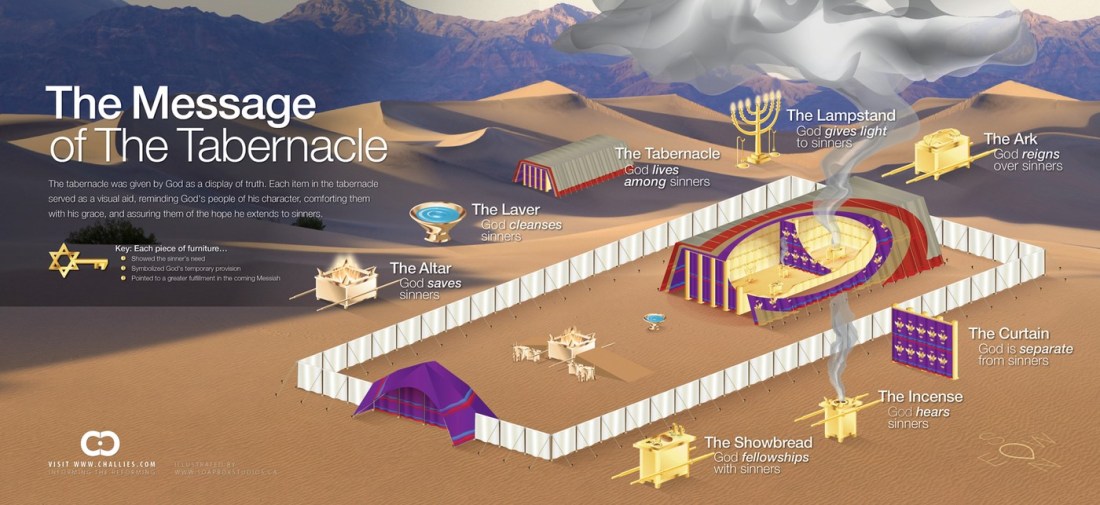
Let me briefly share with you the basic lessons of each and then you and I will be edified:
- The Tabernacle: is the earth in which all sinners are. And the Tabernacle or that tent teaches us that we have our beginning and being in God. He is not only God with us, but he is the God in who we are.
- The Outer Court: In the Israelite setting it was for public use, it was an area where a sinner with his sacrifice approached the Priest for Sacrifice. It is the world of believers and non-believers. It is an arena of choices. Where we make a choice to approach the priest or not.
- The Altar: this is where the Sacrifice is killed, and this cannot mean any other thing but the Cross upon which Jesus who is the Old Testament sacrificial lamb was killed. These altars were important in the Old Testament and most worship was conducted upon it.
- The Showbread: this symbolized Jesus Christ as the unleavened bread of Life which every sinner should feed on if he is to overcome the sin and its leaven.
- The Incense: In the Old Testament, it symbolized a smoke that linked God to the burnt offering. In the reformation age, it was the prayers of the saint. In Christian Theology, it is God the Holy Spirit that fills our lives though not in sight as he used to be in flesh.
- The Curtains: this taught us how the savior and the sinner are distinct, separate and distant in nature, thought, and behavior but still with a possibility of access to each other initiated by the savior. That is why it’s a curtain and not a wall. And we all know that this got torn apart upon the death of Jesus Christ.
- The Laver: This was there to teach us what the New Testament emphasizes that Christ is the living water not for refreshment but the water that cleanses us of our sins. While his blood redeems and restores our life, his water cleanses us of the dirt of sin. When he died, it was blood and water that came out of his ribs. Jesus is the Laver or the basin that cleanses all of us of our sin before we enter heaven. Just like those washing sinks in hotels that we use before our meals, Jesus is that to our sin-dirt.
- The Priests: These were a link between God and man. However, they were not angels but fellow men. The difference was that they had to be a little bit cleaner than those they represented. When they entered the Holy of Holies, they had chains bound on their ankles just in case the expected happened, the unclean touching the clean equals death. They could be pulled back as dead bodies.
These represented Jesus in two capacities and misrepresented him in one fundamental area. They represented him as God incarnate, he was 100% a human being with possibilities to sin and fall. He was equally vulnerable like you and I are. Secondly, they were the connection between the right and the wrong and always reconciled the two upon the death of a lamb.
Jesus is the link between us sinners and himself God almighty. No one outside, beyond or beside God can reconcile us to him. God is the mediator between us and himself, no other force came from anywhere to do this. The human priests always misrepresented Christ in one sense, they sinned in the flesh but Jesus was perfect in the same flesh, and that is what sets him apart as the true priest in the former examples.
- The Ark: In this was the Law that I discussed already, (please refer to previous chapters), and later the book of the penal code. And on it was both a Mercy and Justice seat. The Ark represents the truth that God is JUST. And his justice can be understood through our utter failure to keep the law, our disobedience to obey his commandments and worst of all, our rejection of the provisions he has made for every failure. And that provision is being Saved by Grace through Faith alone.
On the Ark, also was where the Shekinah was present, and that presence of God encouraged the afraid that God is with them, and it also warned the hiding and fugitive guilty sinners that God’s presence is inescapable. The Ark of the Covenant is therefore, evidence for what we have failed and God has kept on our behalf and has died in our stead to save us from what we deserve and give us what we do not deserve. And if we refuse this free gift, then we are destined for God’s justice which entails giving us what we deserve aka DEATH. Salvation is injustice exercised by the love and gracious nature of God. I wish people knew this and the reason they have failed to understand this is because they have not observed the last teaching aid:
- The Lampstand: This meant nothing but light. Christ is the Light of the sin-darkened world. The problem with us is that some of us have lived in darkness for a long time to the extent that we have started seeing but in the darkness. We are too accustomed to darkness to the extent that when real light shines upon us, it hurts. Christ is not just literal light for sight, but he is most importantly the light that shines our insights. You and I do not need sight alone, (almost everyone has) but we need insight too. We need Jesus the Holy Spirit to show us things we cannot see by our academics and all sorts of talent and expertise. The world might have all sorts of lights and lightening, but Christ is the complete and absolute light. That is the reason the lampstand had seven hands; seven is a symbol of completeness.
19th January Evening
Exodus 32-33
Chapter 32 is one that is about nothing but the problem with COMPROMISE. Aaron was a compromising and a compromised leader. He knew this crowd ever since Egypt, he knew they were complaining slaves. He knew they were inconsistent and not dependable. He knew what they demanded was not right, in a sense he knew they were wrong in what they demanded but he went ahead and participated in their wrong. He had excuses for his compromises, like many of us who do, have.
Compromise is a dangerous sin to leaders. We must avoid the spirit of PEOPLE-PLEASING. Perhaps Aaron wanted to take the place of Moses and become the new leader by lowering the standards that Moses had set. Perhaps he wanted to appear better than Moses. We do not know why this brother compromised but this was bad and wrong as well. Many times when we stand in the queues for a long time and when those connected to the superintendents of the queues come, these leaders break their own rules.
Compromise can be caused by fear of the consequences, it can be caused by self-interests, it can be engineered by favoritism and sometimes we compromise because we fail to control ourselves. To avoid compromising set realistic rules, be faithful to death, stop people-pleasing. And always do what is right.
Chapter 33 is pay time. Every sin has its consequence. The Israelites have messed up God and he is now set to destroy them. Tension is on in the camp and the first thing God says is in verse 5-6: For the LORD had said to Moses, “Say to the people of Israel, `You are a stiff-necked people; if for a single moment I should go up among you, I would consume you. So now put off your ornaments from you, that I may know what to do with you.'” Therefore the people of Israel stripped themselves of their ornaments, from Mount Horeb onward.
It was in this jewelry that they made the calf. Sometimes when your material wealth is innovated into your god, God has no option but to strip it from you. You need to destroy those things in your life that are the raw material of the idols in your life. My friends. Catch you tomorrow.
God bless you. I invoke TRUTH, KNOWLEDGE, and FAITH.
Am Pr. I.T.White. THE GOSPEL HAWKER
@Think and Become (Inspirational Link)
iTiS Well of Worship Ministries John 4:24
 iTiS Well of Worship Fellowship (John 4:24)